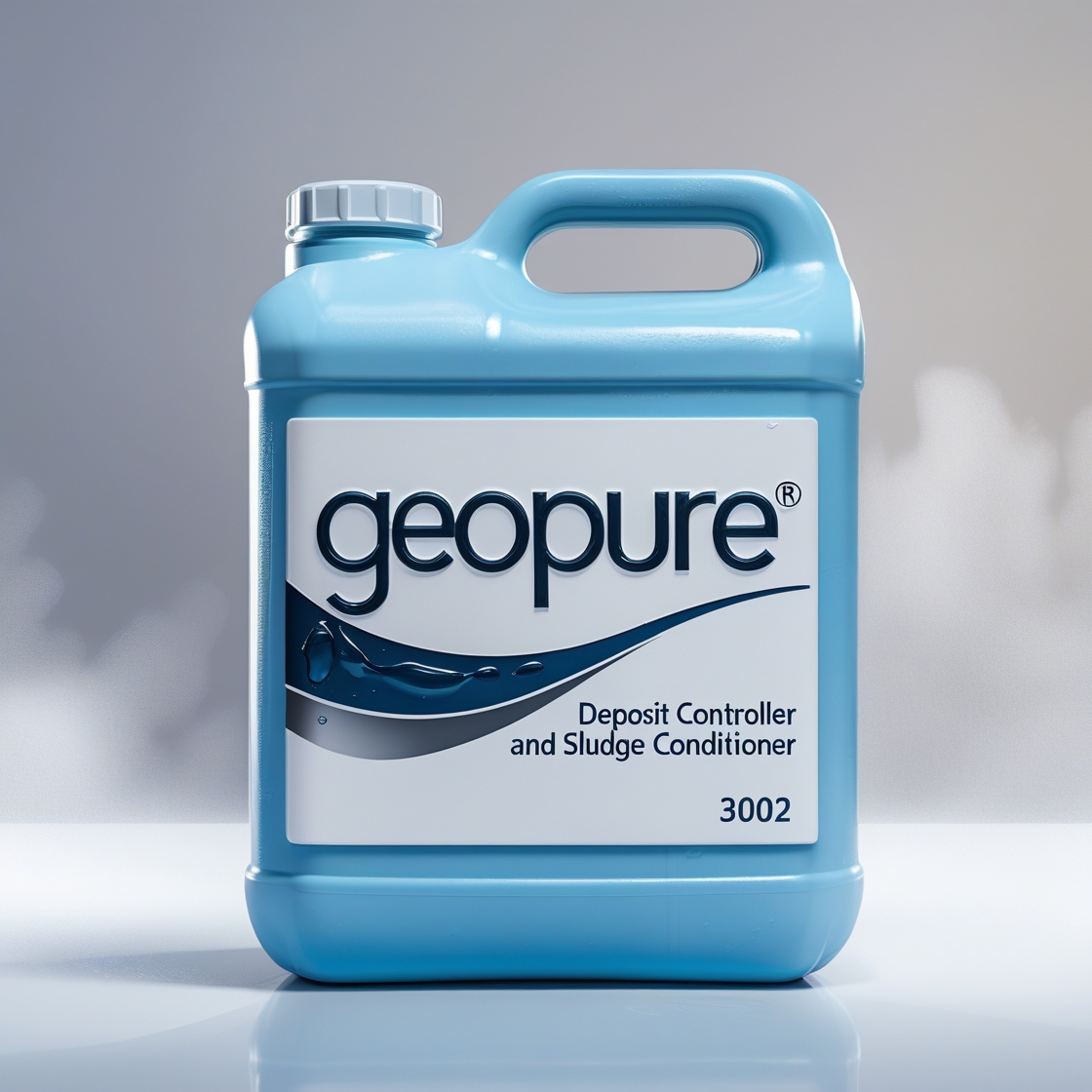
Threshold Deposit Controller &
Sludge Conditioner
Geopure® 3002 is a specialized treatment solution designed
to control scale deposition, disperse suspended solids,
and prevent corrosion in open recirculating cooling water
systems. Its advanced formulation provides threshold
inhibition of mineral scaling, ensuring that hardness
salts remain soluble and do not settle on heat transfer
surfaces.
In addition to deposit control, Geopure® 3002 functions as
a sludge conditioner, keeping particulate matter in
suspension for easy removal through blowdown. It offers
excellent protection for both ferrous and non-ferrous
metals, extending equipment life and improving operational
reliability.
- Physical Status:Liquid
- Appearance:Clear
- Solubility in water:Complete
- Specific Gravity @ 25ºC:1.09 ± 0.05
- H (10% Solution):1.0 ± 0.5
Physical Properties:
- Dual-Action Performance: Combines deposit control with sludge conditioning for cleaner systems.
- Scale Prevention: Inhibits calcium carbonate, calcium sulfate, and other common mineral scales.
- Enhanced Heat Transfer: Maintains clean surfaces for improved cooling efficiency.
- Corrosion Protection: Safeguards a variety of metals, including copper and alloys.
- Sludge Dispersal: Keeps suspended solids from settling and forming deposits.
- Wide Operating Range: Performs effectively across varied pH, temperature, and hardness conditions.
- Operational Efficiency: Reduces maintenance downtime and energy losses.
- Program Compatibility: Can be used alongside oxidizing and non-oxidizing biocides
Dependant on level of calcium hardness in makeup. However, an average dosage would expect to maintain 50 to 100 ppm of Geopure 3002 within system for calcium hardness levels up to 600 ppm.
| Proper human safety products such as Splash goggles, lab coat, vapour respirator, gloves and boots should be worn while handling and applying chemicals. Splashes on skin should be washed off with water immediately. In case of splashing into the eyes, flush it with fresh water and obtain medical attention. Should not be injected. Please refer MSDS for more details. |